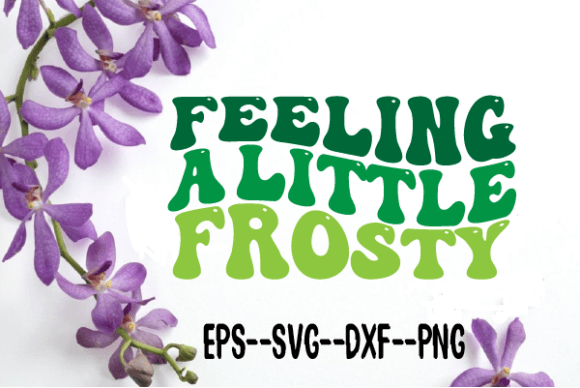
Review: Feeling a Little Frosty Christmas Wavy for Embroidery
As a designer who spends half my life digitizing and the other half stitching, I have learned to look past the flashy preview images. When I first opened the file for Feeling a Little Frosty Christmas Wavy, my immediate reaction was not just about the aesthetic appeal, but about its structural integrity on fabric. This design, marketed primarily as a Christmas retro wavy SVG sublimation design, presents an interesting challenge for those of us working in the tactile world of thread. While the product description highlights its use for printable sublimation on items like T-shirts, mugs, and pillows, I wanted to see if this graphic could translate effectively into a high-quality machine embroidery design for real-world craft business applications.
The Visual Personality and First Impressions
The mood of Feeling a Little Frosty Christmas Wavy is undeniably nostalgic. It captures that mid-century modern holiday vibe that has become so popular among Etsy sellers and boutique owners. The wavy lines suggest movement and softness, which is a welcome departure from the rigid, geometric patterns we often see in holiday graphics. For an embroidery project, this fluidity is both a blessing and a curse. Visually, it promises a handmade product that feels approachable and warm, perfect for personalized gifts or small shop merchandise.
However, from a technical standpoint, wavy lines require careful handling. In a digital graphics context, curves are smooth. In embroidery, curves are made of straight stitches. My primary concern when reviewing this asset was how those waves would render in satin stitch or fill stitch without looking jagged or losing their retro charm. The layout appears balanced, with enough negative space to allow the fabric texture to breathe, which is crucial for maintaining a professional look in custom apparel.
Real-World Application: The Holiday Sweatshirt Test
To truly evaluate this design, I imagined a specific scenario: creating a limited run of holiday sweatshirts for a local craft fair. I chose a heavy cotton-blend fleece, a common substrate for winter wear. The goal was to place Feeling a Little Frosty Christmas Wavy on the left chest area, a standard spot for subtle branding or festive accents.
In this context, the design performs well because of its simplicity. Unlike complex applique designs that require multiple layers and trims, this graphic relies on line work and shape. If digitized correctly, it would likely utilize a combination of running stitch for outlines and a light fill stitch for any solid areas. This reduces bulk, which is essential for comfort in wearable items. Customers reacting to such a piece would likely appreciate the clean, crisp lines that do not feel heavy or stiff against the skin. It fits seamlessly into the category of Crafts that prioritize wearability alongside aesthetics.
Considerations for Different Fabrics and Hoops
While the design shines on stable fabrics like cotton twill or fleece, I would advise caution when using it on stretchy materials or thin fabrics. The wavy nature of the graphic means that any distortion in the fabric will be immediately visible in the stitch pattern. For a tote bag design, where the fabric is usually sturdy canvas, this is less of an issue. However, for baby embroidery on delicate knits, you must ensure your stabilizer choice is robust. A cut-away stabilizer might be necessary to prevent the waves from puckering after washing.
Another critical factor is hoop size. If you are planning to scale this down for a cap or a small embroidered patch, you must check the stitch density. Tiny details can get lost if the design is reduced too far. I recommend testing the design on scrap fabric at your intended size before committing to a finished product. This is especially true if you are using it for dark fabric, where thread color contrast becomes vital. A light thread on a dark background can highlight imperfections in stitch coverage, so your digitizing settings need to be precise.
Commercial Viability and Brand Consistency
For small business owners and digital product sellers, the versatility of Feeling a Little Frosty Christmas Wavy is a major selling point. Although the provided files include DXF, EPS, and SVG formats typically used for cutting machines and sublimation, the visual asset itself serves as an excellent reference for embroidery digitizers. You can use the SVG as a template to create a custom embroidery file that matches your specific machine’s capabilities.
This approach allows for greater control over stitch density and thread colors. By converting the graphic yourself or hiring a digitizer, you ensure that the final embroidery project aligns with your brand consistency. Whether you are creating kitchen towels, pillow covers, or nursery decor, having a unique embroidery file derived from this popular graphic can set your handmade product apart from mass-produced items. It adds a layer of professionalism and buyer engagement that generic clip art simply cannot match.
Practical Designer Notes for Best Results
- Test on Scrap Fabric: Always stitch out a test sample to check for puckering or thread breaks, especially with the curved sections of the wave.
- Check Thread Contrast: Use high-contrast thread colors initially to inspect stitch clarity, then switch to your desired palette for the final product.
- Review Stitch Density: Ensure the density is appropriate for your fabric type to avoid stiffness or fabric distortion.
- Confirm Hoop Size: Verify that the design fits within your machine’s hoop dimensions without needing excessive re-hooping.
- Inspect Small Details: Zoom in on the digital file to ensure no lines are too close together, which could cause thread nesting.
- Use Proper Stabilizer: Match your stabilizer to the fabric weight; heavier fabrics may need less support, while stretchy knits require more.
- Verify Licensing: Since the original product is sold as a sublimation design, confirm with the creator if you have the rights to use the visual for commercial embroidery sales or if you need a separate license for the digitized version.
Final Verdict on Feeling a Little Frosty Christmas Wavy
In conclusion, Feeling a Little Frosty Christmas Wavy is a strong candidate for holiday embroidery projects, provided it is handled with technical care. Its retro aesthetic appeals to a wide audience, making it suitable for everything from custom apparel to home decor. While it originates as a Graphics asset for sublimation, its clean lines and balanced composition make it an excellent base for creating high-quality machine embroidery designs. By paying attention to fabric texture, stabilizer choice, and stitch density, you can transform this digital file into a tangible, high-value handmade product that customers will trust and love. For the experienced crafter, it offers a blend of nostalgic charm and modern simplicity that is hard to resist during the busy holiday season.