Reviewing Heifer Please Kitchen SVG for Embroidery
As a designer who spends half my life staring at stitch simulations and the other half pulling tangled thread out of bobbins, I have learned to be skeptical of digital assets. We see thousands of files marketed as "ready to use," but few survive the transition from screen to fabric without significant tweaking. Recently, I came across Heifer Please,Kitchen SVG, a design that initially caught my eye for its playful typography and rustic charm. While the product description highlights its utility for t-shirts, posters, and mugs, my interest lies in how this graphic translates into a tangible, stitched embroidery project.
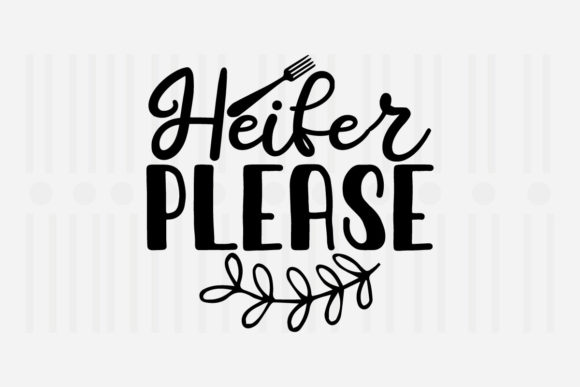
The first impression of this design is one of approachable humor. The phrase itself suggests a lighthearted, farmhouse aesthetic that fits perfectly within the current trend of cozy, personality-driven home decor. Visually, the layout appears balanced, with a clear hierarchy that should guide the eye naturally. For those of us working in Crafts and Graphics, the distinction between a print-ready file and an embroidery-ready file is critical. This asset comes as an EPS and SVG, which are vector formats. This is excellent news for scalability, but it requires a crucial intermediate step: digitizing.
From Vector to Stitch: A Real-World Test
To truly evaluate Heifer Please,Kitchen SVG, I imagined a specific client request. A local boutique owner wanted custom embroidered aprons for her cooking class participants. She needed something durable, legible from a distance, and charming enough to encourage social media shares. I loaded the SVG into my digitizing software to assess its potential. Because the source file is vector-based, scaling the design to fit a standard 5x7 hoop was seamless. There was no pixelation or loss of detail, which is often a problem with raster images.
The mood of the design is casual and inviting. In an embroidery context, this lends itself well to a mix of stitch types. I envisioned the main text rendered in a bold satin stitch to give it dimension and a premium feel, while any accompanying graphical elements could utilize a fill stitch for coverage or a running stitch for delicate outlines. The simplicity of the concept means it does not rely on overly complex shading, which is a blessing for machine embroidery. Complex gradients do not translate well to thread; solid shapes and clean lines do.
Material Considerations and Fabric Behavior
One of the most important aspects of using a design like Heifer Please,Kitchen SVG is understanding how it interacts with different textiles. For the apron project, I selected a medium-weight cotton canvas. This fabric provides enough stability to support the density of the stitches without puckering excessively. However, if you were to apply this same design to a stretchy jersey knit for a sweatshirt embroidery project, the outcome would be drastically different.
On stretchy fabrics, the tension of the thread can cause the garment to warp around the design. To mitigate this, a cut-away stabilizer is non-negotiable. For woven fabrics like tea towels or tote bags, a tear-away stabilizer might suffice, but I always recommend testing on scrap fabric first. The thread colors you choose will also dictate the success of the piece. Since the design is described as "100 Color Changeable," you have the freedom to experiment. A classic white thread on navy blue creates high contrast and readability, while earthy tones like sage green or terracotta can enhance the rustic, farmhouse vibe.
Navigating Small Details and Hoop Sizes
While the design is versatile, there are areas where caution is required. If you plan to downsize Heifer Please,Kitchen SVG for a baby embroidery item, such as a onesie or a small bib, you must pay close attention to the letter spacing. Tiny text can become illegible if the satin columns are too wide or if the letters merge together due to thread expansion. I advise checking the design in a black-and-white mockup at the intended size. If the negative space between letters disappears, you need to adjust the kerning in your digitizing software before stitching.
Similarly, curved surfaces like caps present a challenge. The rigid structure of a cap front requires careful hooping and often a stiffer stabilizer. The design’s layout seems horizontal, which works well for the front panel of a hat, but ensure that the total width does not exceed the usable area of your hoop. For tote bag design applications, the larger surface area allows for a more impactful presentation, making the text easier to read and the humor more immediate.
Commercial Viability and Brand Consistency
For Etsy sellers and small shop product creators, the value of a design lies not just in its aesthetics, but in its marketability. Heifer Please,Kitchen SVG taps into a niche that values humor and domesticity. It is the kind of personalized gift that resonates with home cooks, farmers, or anyone who appreciates a pun. When used in commercial embroidery, consistency is key. If you are building a brand around rustic kitchenware, this design fits seamlessly. However, if your brand is modern and minimalist, the playful font might clash.
It is essential to verify the licensing terms before selling finished items. While the file includes EPS and SVG formats suitable for printing and cutting, using it for machine embroidery typically requires you to create the stitch file yourself. Ensure that your digitized version complies with the creator’s terms of use. Many designers allow the sale of physical finished products but restrict the resale of the digital stitch file. Always clarify this to protect your craft business from intellectual property issues.
Final Thoughts on Design Execution
In conclusion, Heifer Please,Kitchen SVG is a strong candidate for various handmade product lines. Its strength lies in its simplicity and adaptability. Whether you are creating an embroidered patch for a jacket, a holiday embroidery gift for a friend, or inventory for your online store, this design offers a solid foundation. Remember that the SVG is just the starting point. The magic happens in the digitizing process, where you decide the stitch types, densities, and underlay strategies.
Take the time to test different fabric texture combinations. Try it on denim, linen, and cotton. Observe how the light hits the satin stitches and how the shadows define the letters. These small details elevate a simple graphic into a professional-quality finished product. By treating the digital asset with the respect it deserves and applying rigorous technical standards, you can turn Heifer Please,Kitchen SVG into a bestseller for your custom apparel or home goods line.